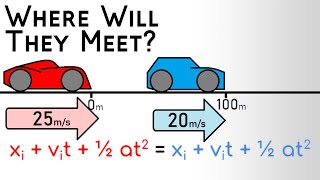
Media Summary: At t=0 car traveling at a constant velocity of 25m/s is 100m behind a car traveling in the same direction at a velocity of 20m/s. I've seen it a thousand times. Students understand everything during class, but then when it comes time to try the Here I go over the equations that describe motion in one dimension. Particularly motion with constant acceleration and look at ...

Two Trains 1d Kinematics Problem - Detailed Analysis & Overview

At t=0 car traveling at a constant velocity of 25m/s is 100m behind a car traveling in the same direction at a velocity of 20m/s. I've seen it a thousand times. Students understand everything during class, but then when it comes time to try the Here I go over the equations that describe motion in one dimension. Particularly motion with constant acceleration and look at ... Alice and Bob are walking towards each other at different velocities. When and where do they meet? This covers: constant velocity ...

Photo Gallery

Two Trains 1D Kinematics Problem
Train Complex Kinematics Problem
Worked Example | Where Will Two Cars Traveling at Different Velocities Meet? | Kinematic Equations
Kinematic Motion in One Dimension | Two trains are traveling along... (Question 3)
Kinematics Part 4: Practice Problems and Strategy
1 D Motion Example 2 Trains
The 2 trains problem.  Two objects are moving towards each other, when and where do they meet?
1D Kinematics - Example Problems (Eqns of Motion)
Physics - 1D Motion Two Trains Traveling the Same Direction HW1.5
1D Kinematics (Linear Motion) - 7 Example Problems | Physics - Kinematics
Solving Kinematics Problems in Physics (1D Motion)
1D Kinematics - Problem 2: Displacement and Velocity (Clip) | Physics - Kinematics
Sponsored
Sponsored
View Detailed Profile
Two Trains 1D Kinematics Problem

Two Trains 1D Kinematics Problem

A solution of the classical "

Train Complex Kinematics Problem

Train Complex Kinematics Problem

A

Sponsored
Worked Example | Where Will Two Cars Traveling at Different Velocities Meet? | Kinematic Equations

Worked Example | Where Will Two Cars Traveling at Different Velocities Meet? | Kinematic Equations

At t=0 car traveling at a constant velocity of 25m/s is 100m behind a car traveling in the same direction at a velocity of 20m/s.

Kinematic Motion in One Dimension | Two trains are traveling along... (Question 3)

Kinematic Motion in One Dimension | Two trains are traveling along... (Question 3)

https://StudyForce.com ✓ https://Biology-Forums.com ✓ Ask questions here: https://Biology-Forums.com/index.php?board=33.0 ...

Kinematics Part 4: Practice Problems and Strategy

Kinematics Part 4: Practice Problems and Strategy

I've seen it a thousand times. Students understand everything during class, but then when it comes time to try the

Sponsored
1 D Motion Example 2 Trains

1 D Motion Example 2 Trains

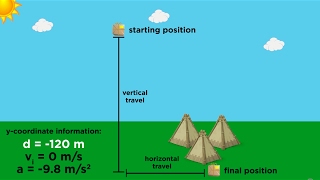
Here I go over the equations that describe motion in one dimension. Particularly motion with constant acceleration and look at ...

The 2 trains problem.  Two objects are moving towards each other, when and where do they meet?

The 2 trains problem. Two objects are moving towards each other, when and where do they meet?

Alice and Bob are walking towards each other at different velocities. When and where do they meet? This covers: constant velocity ...

1D Kinematics - Example Problems (Eqns of Motion)

1D Kinematics - Example Problems (Eqns of Motion)

PREVIOUS VIDEO -

Physics - 1D Motion Two Trains Traveling the Same Direction HW1.5

Physics - 1D Motion Two Trains Traveling the Same Direction HW1.5

In this video we solve HW 1

1D Kinematics (Linear Motion) - 7 Example Problems | Physics - Kinematics

1D Kinematics (Linear Motion) - 7 Example Problems | Physics - Kinematics

Check out the

Solving Kinematics Problems in Physics (1D Motion)

Solving Kinematics Problems in Physics (1D Motion)

I explain how to solve

1D Kinematics - Problem 2: Displacement and Velocity (Clip) | Physics - Kinematics

1D Kinematics - Problem 2: Displacement and Velocity (Clip) | Physics - Kinematics

Check out the

Two trains 1

Two trains 1

... great first step for solving any